Shipments
Sometimes a pickup needs to happen at one location, and be delivered to another, without any depot involvement. Such routing problems are called VRPs with pickup and delivery, and we model it in PyVRP using shipments.
[1]:
import pyvrp
import pyvrp.plotting
import pyvrp.stop
We will investigate a simple example with five shipments, inspired by the example from the OR-Tools documentation.
[2]:
COORDS = [
    (456, 320),
    (228, 0),
    (912, 0),
    (0, 80),
    (114, 80),
    (570, 160),
    (798, 160),
    (342, 240),
    (684, 240),
    (570, 400),
    (912, 400),
]

PICKUP_DELIVERIES = [
    (1, 6),
    (2, 10),
    (4, 3),
    (5, 9),
    (7, 8),
]
The problem has five shipments, and a maximum distance constraint of 3000 on the vehicles. We first define all locations, and reference those when creating the depot and setting up the shipments.
[3]:
m = pyvrp.Model()

for x, y in COORDS:
    m.add_location(x, y)

m.add_depot(location=m.locations[0])
veh_type = m.add_vehicle_type(4, max_distance=3_000)

for pickup_idx, delivery_idx in PICKUP_DELIVERIES:
    m.add_shipment(
        pickup_location=m.locations[pickup_idx],
        delivery_location=m.locations[delivery_idx],
    )

for frm in m.locations:
    for to in m.locations:
        distance = abs(frm.x - to.x) + abs(frm.y - to.y)  # Manhattan
        m.add_edge(frm, to, distance=distance)

res = m.solve(stop=pyvrp.stop.MaxRuntime(1))  # one second
PyVRP v1.0.0a0

Solving an instance with:
    1 depot
    0 clients
    5 shipments
    4 vehicles (1 vehicle type)

    Iters    Time |      Current OK    Candidate OK         Best OK

Search terminated in 1.00s after 28075 iterations.
Best-found solution has cost 3652.

Solution results
================
    # routes: 2
     # trips: 2
   # clients: 0
 # shipments: 5
   objective: 3652
    distance: 3652
    duration: 0
# iterations: 28075
    run-time: 1.00 seconds
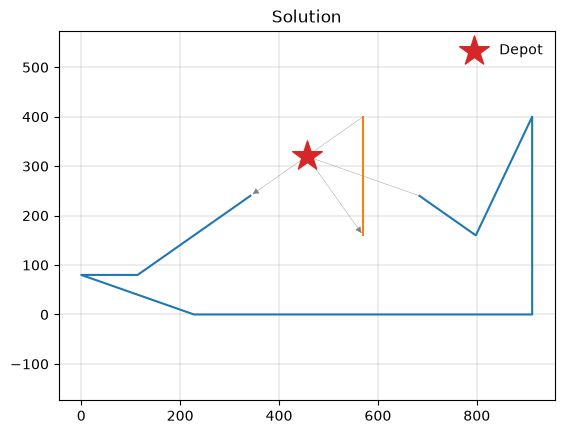
The solution uses two routes because of the maximum distance constraint.
Let’s investigate the solution further. Observe that the shipments are visited twice in each route, for example, as L0 and U0. Here, L0 means that shipment 0 is loaded onto the vehicle (pickup), while U0 indicates it is unloaded (delivery). Of course, pickup of a shipment always precedes its delivery.
[4]:
print(res.best)
Route #1: L4 L2 U2 L0 L1 U1 U0 U4
Route #2: L3 U3
Let’s have a look at the routes PyVRP determined:
[5]:
pyvrp.plotting.plot_solution(res.best, m.data())
Conclusion
You now know how to use PyVRP’s shipment feature. Shipments are useful in many settings, including meal delivery, courier and taxi services, and more. PyVRP’s shipments can also be seamlessly mixed with depot-based clients.